- Huawei proposes replacing traditional "geometric scaling" with "time scaling" to boost chip performance.
- The company expects high-end chips based on this law to achieve a transistor density equivalent to a 1.4-nanometer process by 2031.
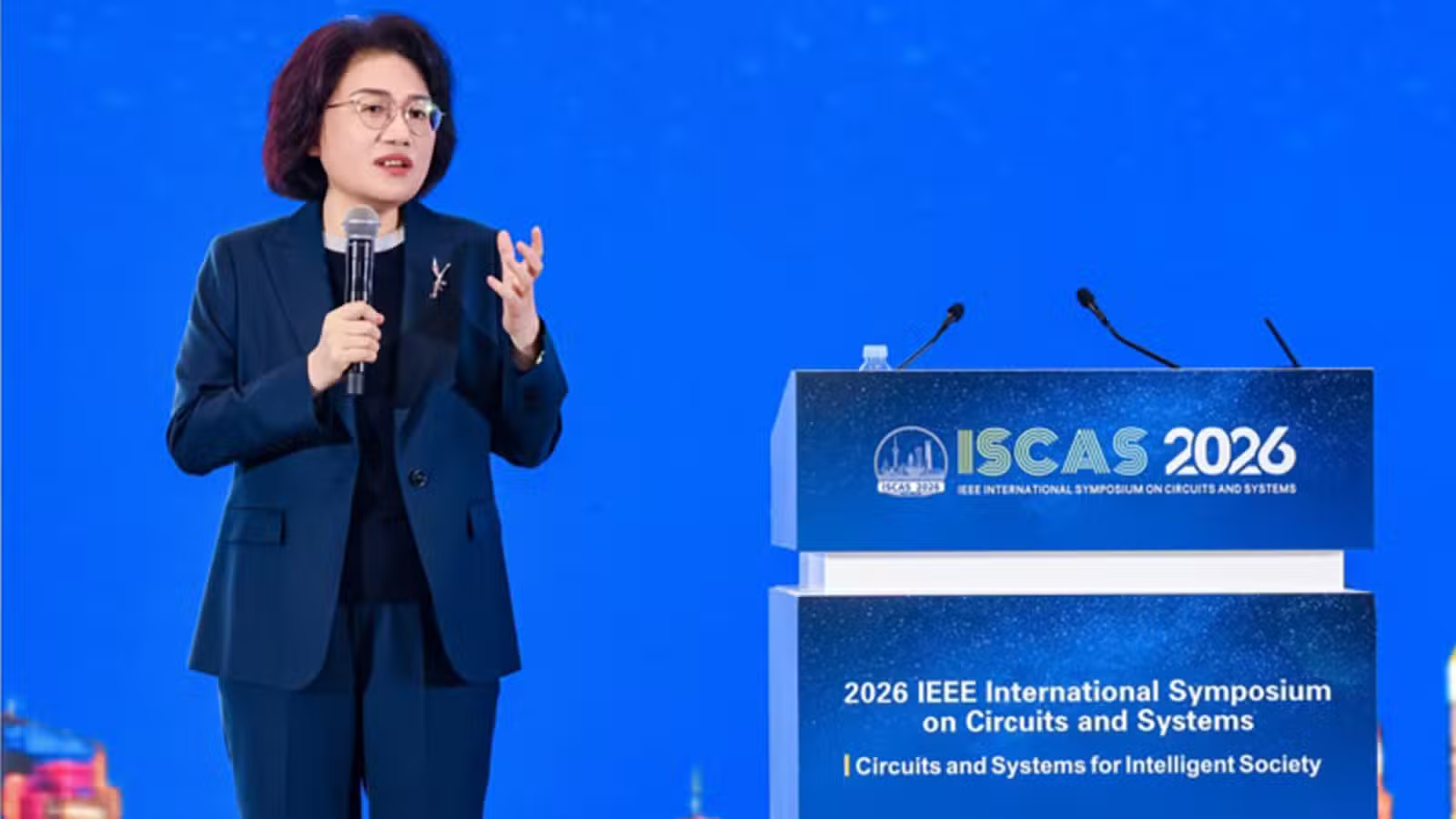
Huawei has unveiled a new semiconductor principle dubbed the "Tau (τ) Law," marking the first time a Chinese company has proposed an industry-guiding principle in the global semiconductor sector.
The principle aims to address the physical limits of Moore's Law, the company said at a symposium held in Shanghai on Monday.
As the pace of transistor shrinkage slows, the global semiconductor industry is in urgent need of a new, sustainable evolutionary path to meet currently exponentially growing demands for computing performance.
The core of the "Tau Law" lies in replacing traditional "geometric scaling" with "time scaling," said He Tingbo, president of Huawei's semiconductor business department.
Tau (τ) is the 19th letter of the Greek alphabet, commonly used in the fields of mathematics, physics, and biology.
The Huawei technology aims to systematically reduce the time constant through innovative methods such as logic folding, thereby continuously compressing signal propagation delay and increasing transistor density.
Based on this entirely new law, Huawei has successfully designed and mass-produced 381 chips over the past six years, demonstrating the technology's viability in commercial applications.
This fall, Huawei plans to release a new Kirin smartphone chip utilizing this new technology, which will fully adopt logic folding to significantly enhance performance.
Huawei has set clear expectations for the long-term development of this technology and built a multi-level collaborative optimization system.
The company expects high-end chips based on this law to achieve a major breakthrough by 2031, reaching a transistor density equivalent to the traditional 1.4-nanometer manufacturing process, it said.
He emphasized the importance of global open cooperation for the industry's future at the symposium, adding that the company looks forward to working with global scientists to jointly drive industrial development.