- Baidu established Baidu Model Committee (BMC) to bring model R&D, technology planning and application implementation into a more centralized decision-making system.
- The committee consists of young researchers with a profound understanding of AI models.
Baidu has set up a new model committee, marking a further centralization of the company's internal model research and development system as China's artificial intelligence race enters the agent phase.
The company has established the Baidu Model Committee, or BMC, local media outlet China Star Market reported on Friday.
Composed of young researchers with a deep understanding of large models, the committee consists of two departments: the Basic Model Unit (BMU) and the Application Model Unit (AMU).
This indicates that Baidu is attempting to integrate basic models, application models and business implementation into a more unified chain of command, the report said.
The newly formed BMC will comprehensively coordinate Baidu's large model initiatives. Everything from path exploration and technology planning to model training and business implementation will fall under its purview, the report said, citing people familiar with the matter.
The arrangement is more than just an organizational restructuring. It reflects Baidu's desire to concentrate its advantageous resources and continuously strengthen its technological edge in AI.
The BMC will include many newly joined, top-tier young technical talents, echoing earlier news of several large model R&D experts joining Baidu.
The new committee is likely to take on a more commercialized mandate. It needs to accelerate the integration of model R&D into products and business scenarios, reducing the disconnect between technological roadmaps and application demands.
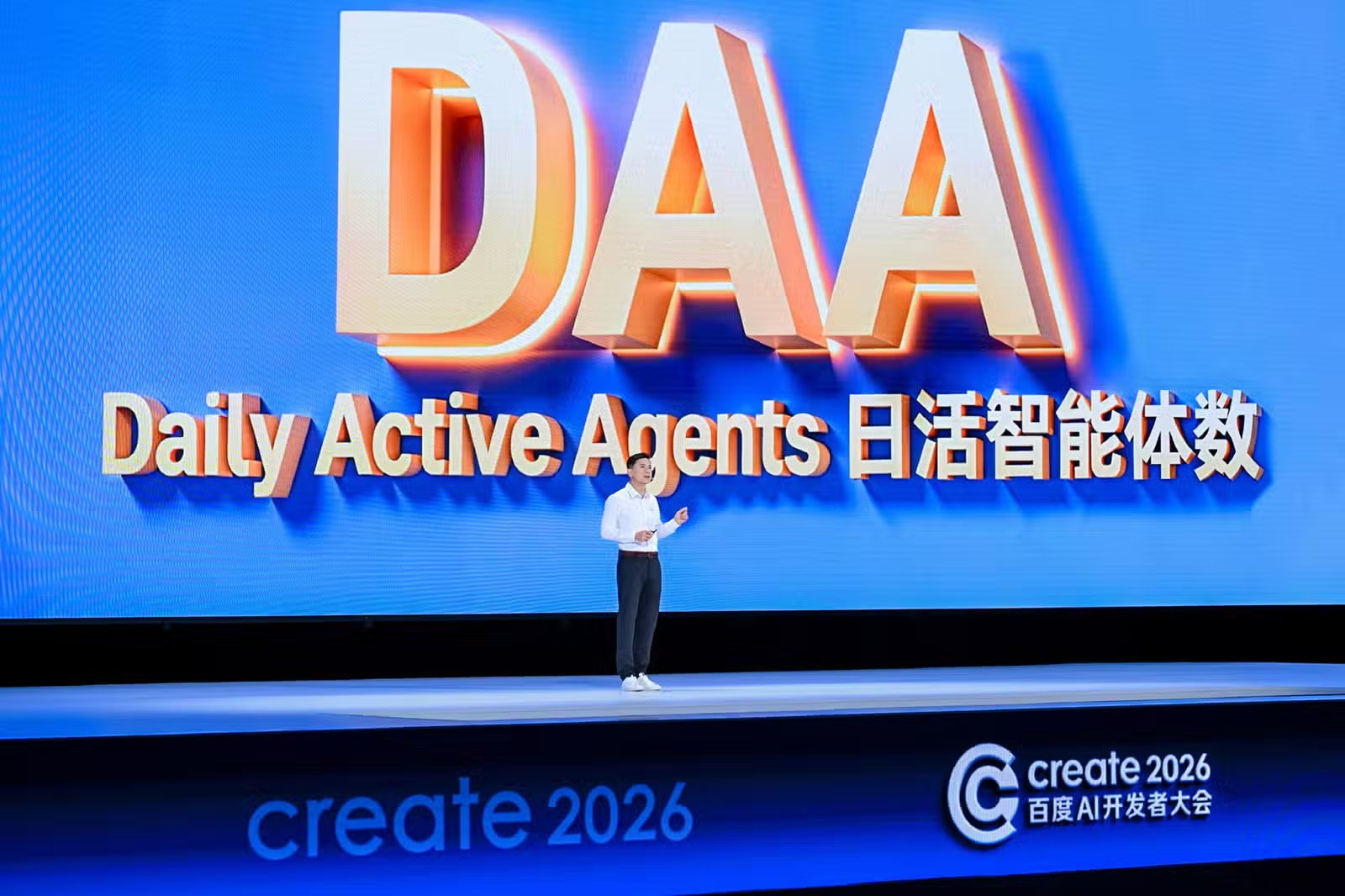
Baidu founder Robin Li proposed at the Create 2026 Baidu AI Developer Conference on May 13 that the metric of the AI era may no longer be token consumption, but rather "Daily Active Agents" (DAA).
Li said the current metric closest to an industry consensus is token consumption. However, tokens represent costs, not returns; they measure input, rather than output.
Baidu hopes to measure the prosperity of the AI ecosystem by how many agents are genuinely working for humans and delivering results.
This provides a clearer context for the establishment of the BMC. What Baidu needs is not just model parameters and computing power investments, but how models can be transformed into agents, tools and measurable business outcomes.
Driven by the wave of agents, the role of developers is changing, Li said. The roles of builder, founder and creator are merging, and every developer could potentially become an entrepreneur and creator.
Chinese AI companies are shifting from competing over model releases to competing on application efficiency, developer ecosystems and commercialization. Baidu's latest adjustment shows its ambition to make internal model resources more deployable.
If the BMC can shorten the path from basic models to application models, it will be easier for Baidu to translate technological investments into product velocity. This is also the core issue in the next phase of competition among AI companies.