- Humanoid robots will be a driving force to lift China's export share, pushing its manufacturing share to 16.5% by 2030, according to Morgan Stanley.
- Morgan Stanley projects the global market size will reach $7.5 trillion by 2050, with China accounting for 30% of global adoption.
Leveraging a comprehensive supply chain layout, China's humanoid robot industry is poised to replicate the growth trajectory of electric vehicles (EVs), according to Morgan Stanley.
Year-to-date in 2026, global venture capital investment in this sector has already surpassed the total for all of last year, with the Chinese market contributing about 46% of the funds.
Chinese companies are accelerating the commercialization of the humanoid robot industry through astonishing speeds of technological iteration and domestic market advantages, a team led by Morgan Stanley analyst Chetan Ahya wrote in a research report on Monday.
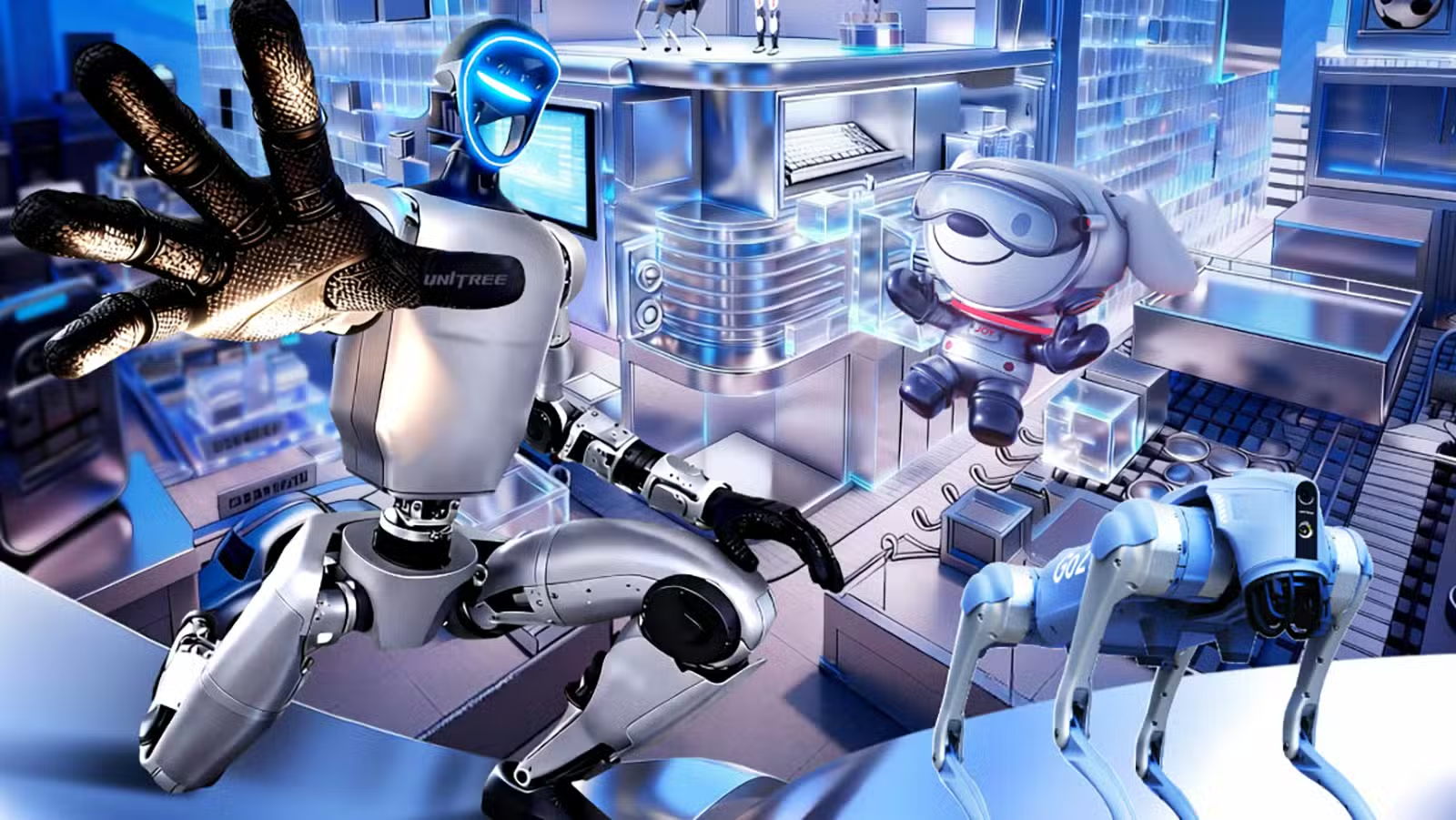
Take Unitree as an example: although its average selling price has dropped to about $25,000, its gross margin remains as high as roughly 60%, demonstrating exceptional early monetization capabilities.
Humanoid robots will act as a catalyst to boost China's export share, which is expected to push its global manufacturing share from the current 15% to 16.5% by 2030, according to Morgan Stanley.
Meanwhile, global tech giants such as Meta and Jeff Bezos are aggressively entering this field — often referred to as "physical AI" — armed with tens of billions of dollars.
In terms of the total addressable market (TAM) in the long run, the global installed base of humanoid robots will reach 1 billion units by 2050, spawning a market worth $7.5 trillion.
By then, China's cumulative adoption is projected to reach about 302.3 million units, accounting for 30% of the global total and far exceeding the adoption scale of the US, Morgan Stanley forecasts.
However, following a recent research trip to Shenzhen, Morgan Stanley also cautioned investors that the rapid development of humanoid robots could trigger excessive competition in the near term and face the risk of excess capacity in the long run.