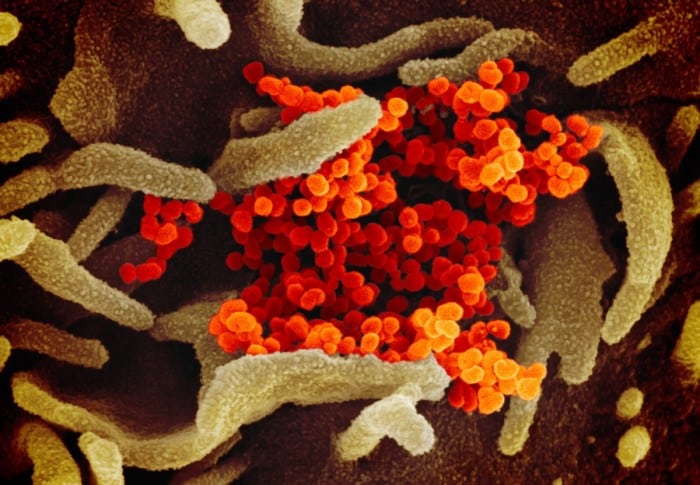
We now know that the main route of transmission of the new coronavirus is through airborne transmission. Droplets produced when an infected person coughs or sneezes can carry the virus.
A healthy person who inhales these droplets or comes into contact with a contaminated surface and then wipes their eyes, nose or mouth can be easily infected.
But what happens when a new coronavirus gets into the water?
There are few reliable studies on novel coronaviruses and their interactions with water, but as Forbes points out, studies of novel coronavirus concentrations in wastewater give us a general idea of the dangers of this transmission pathway.
A study published more than a decade ago in Water Research focused on analyzing SARS, a disease caused by different types of coronaviruses, and two other coronaviruses to determine how long they could survive in water.
What the researchers determined was that the viruses were still powerful even after being soaked in water and sewage for "days to weeks".
That sounds a little scary in itself, but the point is that water or sewage containing the virus itself is not necessarily dangerous. Rather, it is when these liquids are aerosolized that they become a danger to the public.
In addition, the actual number of viruses in any water source also plays a large role in whether new infections are likely to occur.
Just because an infected person swims in a pool does not mean that the pool is now a hotspot for the new coronavirus, especially if it has been properly chlorinated, which will kill the virus completely.
That doesn't mean we should be overly concerned about our water either.
The guidance issued by the U.S. EPA states that the risk of water supply is low and there is no reason to believe that drinking water can be used as a transmission route.
Those at greatest possible risk of contracting coronavirus through water sources are those who work with sewage.
The CDC notes that "standard practices" already used by wastewater treatment workers should be sufficient to protect them from infection.
Special Report: Fighting The New Coronavirus