- Unitree's humanoid robot has reached a tested peak speed of 10 meters per second, rapidly approaching Jamaican sprinter Usain Bolt's human limit of 10.44 m/s.
- Although the "ChatGPT moment" for embodied AI software is still years away, the company expects its robot shipments to surge to as many as 20,000 units this year.
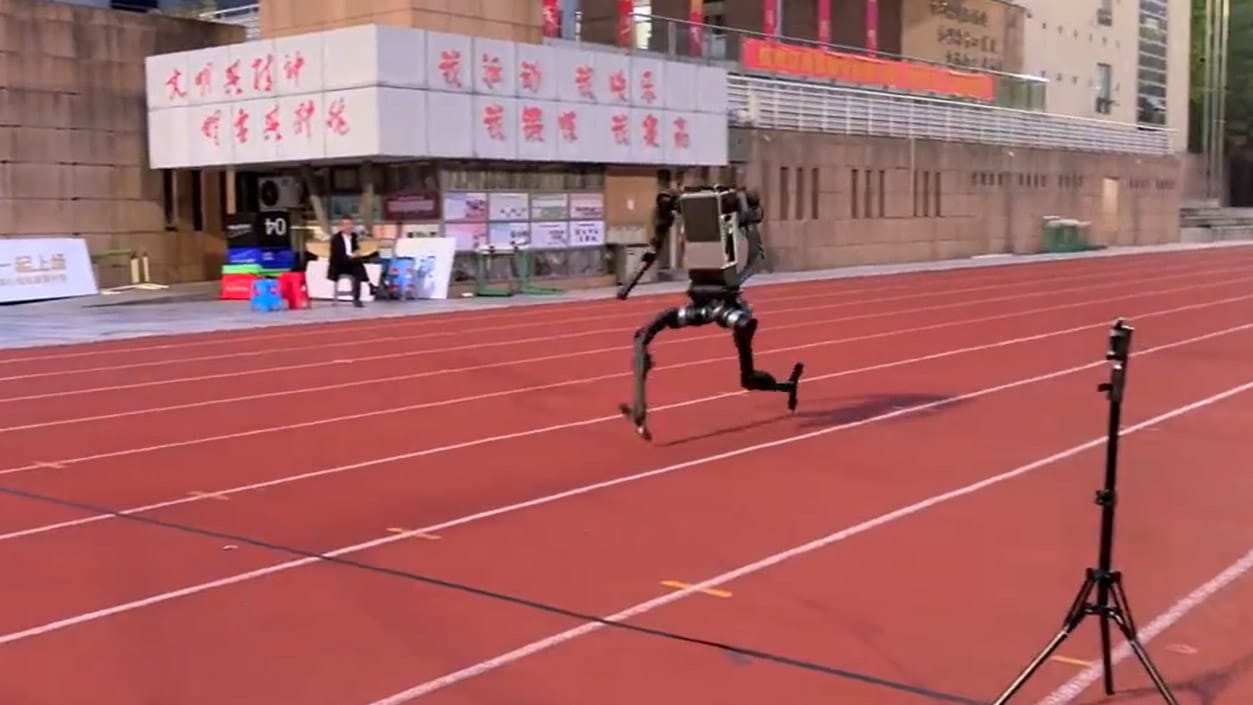
Humanoid robot startup Unitree announced that its robot has set a new world record for speed, a breakthrough signaling that Chinese humanoid robots are rapidly closing in on the physical limits of human athletic ability.
The humanoid robot achieved a tested peak speed of 10 meters per second during a recent 100-meter sprint test, according to an official announcement released by Unitree on April 11.
This achievement leaves only a marginal gap between the robot and the human peak speed of 10.44 m/s held by Jamaican sprinting legend Usain Bolt.
The record-breaking H1 robot possesses a physique similar to an average human, with a total leg length of 0.8 meters and a weight of approximately 62 kilograms, according to the company.
In August 2025, the company's H1 robot set the previous global speed record for humanoid robots by running at 3.3 m/s.
In less than a year, the Chinese robotics industry has made significant strides in the race for hardware speed and athletic capability.
Unitree founder Wang Xingxing predicted at the Yabuli Forum last month that humanoid robots will run faster than Usain Bolt by the middle of this year.
Wang expects that by then, the 100-meter sprint speed of humanoid robots could successfully break the 10-second barrier, thereby surpassing the human world record of 9.58 seconds.
Notably, a related research institute at Zhejiang University also unveiled a full-size humanoid robot in February this year, claiming a peak speed of 10 m/s.
While robot hardware speeds continue to achieve major breakthroughs, the "ChatGPT moment" for embodied intelligence at the software level still requires patience.
Wang said that the industry currently faces main challenges such as insufficient generalization capabilities of AI models, a scarcity of high-quality training data, and the need to improve the scale effect of reinforcement learning.
Completely overcoming these complex technical difficulties and achieving new major breakthroughs on the software front will likely take about two to three years to gradually accomplish, Wang said.
Although the full maturity of software technology will take time, China's largest humanoid robot manufacturer, founded in 2016, is entering a period of explosive commercialization.
Wang predicts that global shipments of humanoid robots will reach tens of thousands of units in 2026, with Unitree's target shipments for this year set at 10,000 to 20,000 units, representing a significant increase from its 5,500 units shipped in 2025.